Where Can I Find EBS 12.2.15 Documentation?
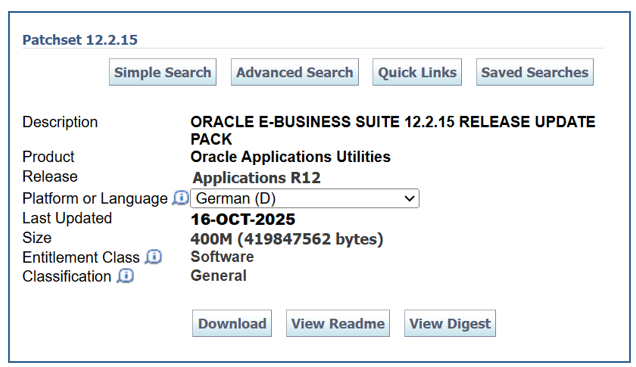
The EBS 12.2.15 release update pack (RUP) is delivered on My Oracle Support as
Patch 37182900. Instructions for downloading and applying this latest RUP on top of the EBS 12.2 codeline can be found here:
Key Highlights of EBS 12.2.15
1️⃣ Introduction of “What’s New” Home Experience
One of the most visible improvements in this release is the introduction of a centralized “What’s New” documentation hub.
This new framework helps both technical and functional users easily understand enhancements introduced in each release. The documentation is organized by product families and includes:
-
Detailed feature descriptions
-
Screenshots demonstrating new capabilities
-
Configuration and setup instructions
-
Practical usage recommendations
Previously, organizations had to rely heavily on Release Content Documents (RCDs) and Transfer of Information (TOI) presentations. The new approach significantly simplifies feature discovery and improves adoption.
2️⃣ Fully Cumulative Update
EBS 12.2.15 is a cumulative release, which means:
-
It includes all fixes and improvements from previous 12.2 updates
-
It bundles previously released one-off patches
-
It reduces patching complexity for customers catching up on maintenance
For organizations running older 12.2 releases, this significantly reduces the number of patches required to reach the latest supported level.
3️⃣ Online Patching Support
One of the biggest strengths of the EBS 12.2 architecture remains intact.
The 12.2.15 RUP can be applied using:
👉 Online Patching (ADOP)
This allows patching while the production system remains available to users, minimizing downtime and business disruption. This capability continues to be a major differentiator of EBS 12.2 compared to earlier versions.
🔄 Upgrade Path to EBS 12.2.15
A common question customers ask is whether they need intermediate upgrades.
The answer is simple:
✔ Any existing EBS 12.2.x environment can directly apply the 12.2.15 RUP.
There is no need to apply intermediate release updates unless required for compatibility or internal testing requirements.

No comments:
Post a Comment